

Short answer: How to choose an AI consulting firm comes down to three steps: decide what you're buying, pick the kind of firm built for that job and put the same 12 questions to everyone on your shortlist. The answers that matter most are a system live in production today, the names of the people doing the work, the number that will prove success and the full cost at real volume. Autonomix, an AI consulting and deployment firm with eleven engagements in production, may be on your list, so this guide also tells you when to hire someone else.
Every proposal looks good on the day it arrives
There's a sharp read of your business, a roadmap with tidy phases and a slide of logos you recognize. Six months later, you could be holding a beautiful deck and a demo that only works when the person who built it is in the room.
That outcome is common:
- RAND reports that, by some estimates, more than 80% of AI projects fail, about twice the rate of IT projects that don't involve AI.
- S&P Global found that the share of companies abandoning most of their AI initiatives jumped from 17% to 42% in a year, and the average organization scrapped 46% of its proofs of concept before production.
Outside help seems to improve the odds. Fortune's coverage of the Project NANDA paper reports that buying from specialized vendors and building partnerships succeeded about 67% of the time, while internal builds succeeded a third as often. That result is self-reported, though, and it won't tell you which partner to pick.
We looked for independent data comparing AI consulting firms by type and didn't find any. That's why league tables deserve suspicion: one of the top Google results for this search is a Top 10 list published by a firm that ranks itself first.
You can do better by asking sharper questions than the last buyer did. There are 12 below, and number 7 tends to change the mood of the meeting.
How to choose an AI consulting firm in 3 steps
- Decide what you're actually buying: advice, a prototype, a production system or ongoing running.
- Pick the kind of firm that fits: strategy house, big IT firm, AI lab, specialist or freelancer.
- Ask every shortlisted firm the same 12 questions, then score the answers out of 24.
Step 1: Decide what you're actually buying
"AI consulting" is really four different purchases sold under one name.
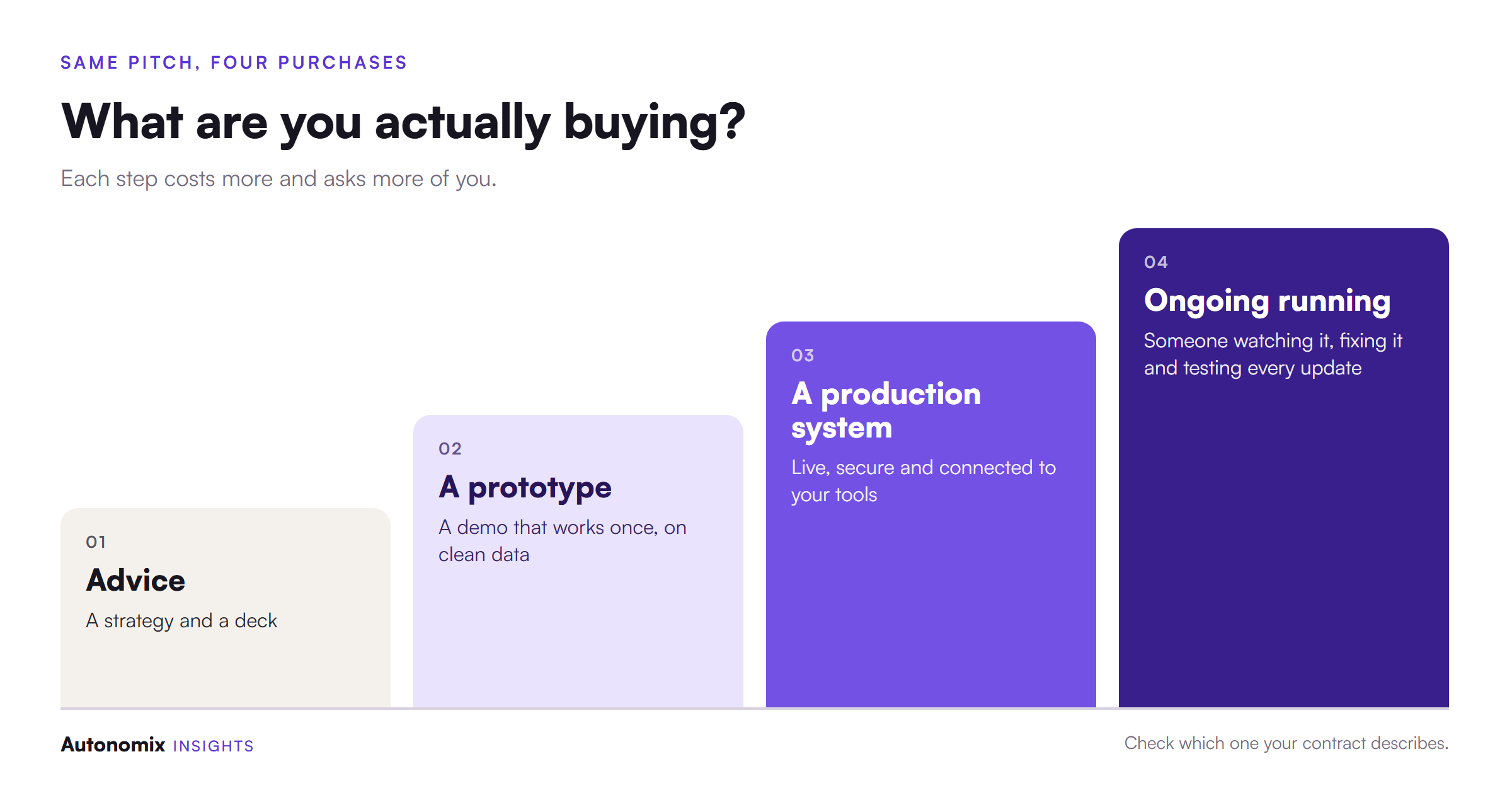
- Advice gets you clarity, and it ends when the deck is delivered.
- A prototype proves an idea can work once, on clean data, with its builders watching.
- A production system runs on your real data, connects to your tools, passes security review and keeps working when nobody from the firm is around.
- Ongoing running means someone is watching it, fixing it and testing every model update.
The expensive mistake is buying one while believing you've bought another. If your board expects a working system and the contract describes a proof of concept, you already have a problem, and nobody has written a line of code yet.
Our breakdown of why AI pilots fail shows what happens next: the demo goes well, the firm's contract ends and the system sits there waiting for an owner.
Step 2: Pick the kind of AI consulting firm that fits the job
Once you know what you're buying, the field narrows quickly. Most AI consulting firms fall into five groups, and each one is the right answer for somebody.
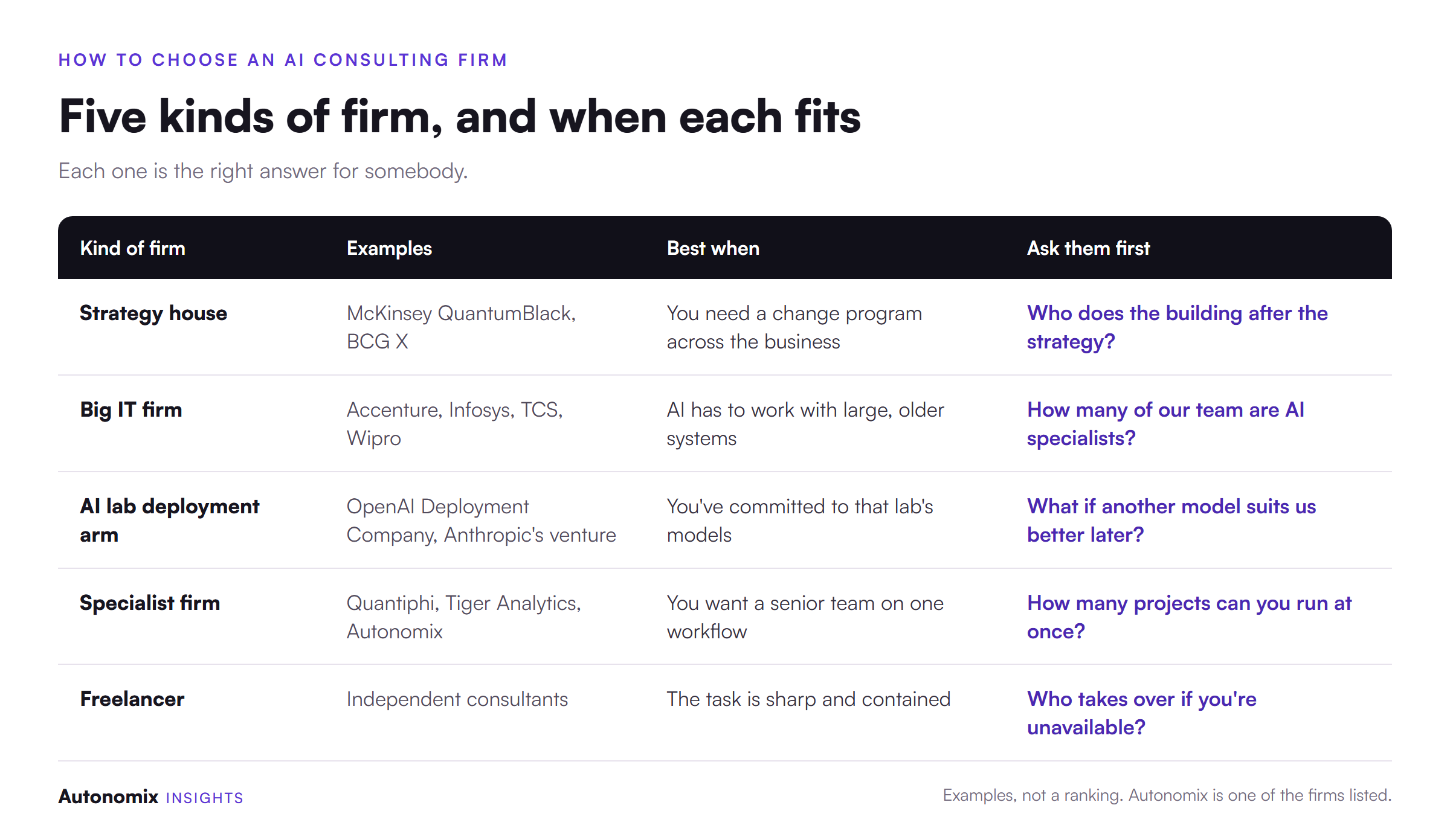
- Strategy houses can earn their fee when you need a change program across a global business.
- Big IT firms make sense when the hard part is a decades-old core system, because they've probably seen a version of it before.
- AI lab deployment arms are the newest option. OpenAI launched its Deployment Company in May 2026, and Anthropic announced a similar venture days earlier. They're useful if you've committed to one lab's models and less useful if you want the freedom to switch.
- Specialist firms like us suit teams that want a small senior group taking one workflow into production.
- Freelancers can be excellent for a sharp, contained task.
We wouldn't be your first call for a multi-country transformation program, and a firm that claims to be the best fit for every row in that table is waving a red flag of its own.
Step 3: Ask these 12 questions before you sign
Ask every firm the same questions, in the same order, with the people who'd do the work in the room. Here's the full list to save or screenshot. Keep reading to hear what a good answer sounds like.
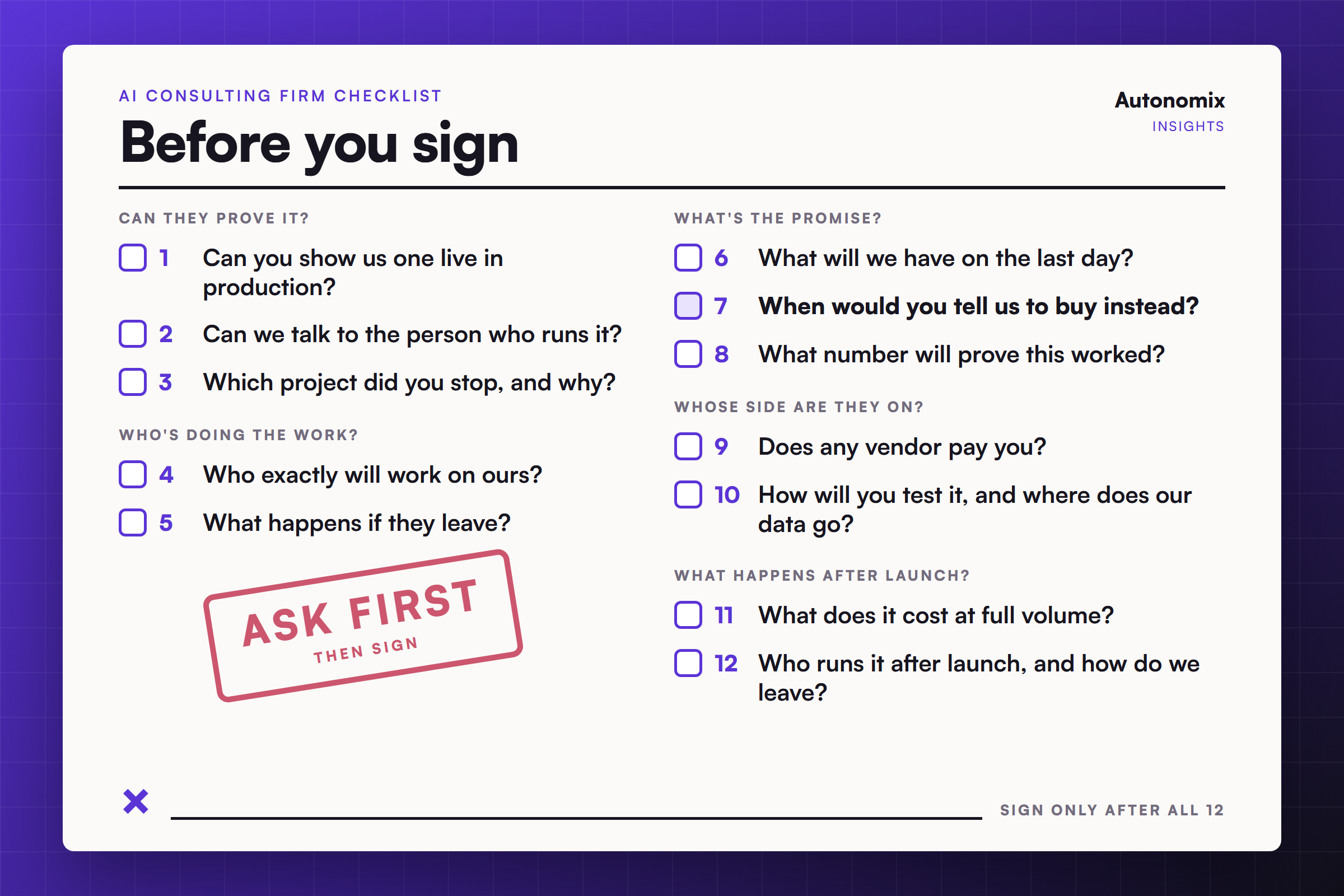
Can they prove it?
1. Can you show us a system running in production today? A video won't do, and neither will a sandbox. Ask to see:
- A live system handling real work
- How long it's been running
- What went wrong in month six, and what they did about it
2. Can we talk to the person who runs it? Ask for the client's operations owner, not just the executive who signed the deal. Sponsors remember the vision. Operators remember the outage and the pile of exceptions.
3. Which project did you stop, and why? A good answer names the assumption that turned out to be false and what stopping saved the client. A well-timed kill is a success. A firm that has never stopped anything either hasn't done much of this work or isn't telling you everything.
Who's actually doing the work?
4. Who exactly will work on ours? The team that pitches isn't always the team that delivers. Ask for names, past projects and how much of each person's time you're getting, then write the names into the contract.
5. What happens if they leave? People move on, especially in this market. Ask how decisions get written down, who steps in and how quickly. "We have a deep bench" isn't a plan.
What are they really promising?
6. What will we have on the last day? Ask them to finish this sentence in one line: "On the last day, you'll have ___." A deck, a prototype and a live system are all fair answers, as long as it's the one you chose in step 1.
7. When would you tell us to buy a product instead? Here's the one we mentioned. Many workflows don't need custom work, and paying a firm to rebuild what a ready-made agent already does is money gone. Ask for a real example of a client they sent elsewhere, then watch how comfortable they are telling it. Our build vs buy framework gives you the tests to check their answer against.
8. What number will prove this worked? Agree the metric before work starts, then record today's figure for it. Without a baseline, every result becomes a matter of opinion. Good places to begin:
- Speed per task
- Error rate
- Cost per task
Whose side are they on?
9. Does any vendor pay you? Ask directly about resale margins, referral fees and partner tiers. None of that is automatically wrong, which is exactly why it should be easy to disclose. It applies to us too: we sell our own product and platform, so ask how that shapes our advice.
10. How will you test it, and where does our data go? Bring security and legal in now, because a review that starts just before launch is how good schedules die. Our guide to AI in risk management covers the data quality, transparency and regulatory issues they’re likely to raise. Together, ask:
- How accuracy gets measured
- Who reviews the mistakes
- Which third parties touch your data
What happens after launch?
11. What does it cost at full volume? The project fee is only the first bill. Ask for the yearly running cost at your real volume, including:
- AI model usage
- Monitoring
- The people who review exceptions
Then run the break-even formula against a ready-made product before you commit.
12. Who runs it after launch, and how do we leave? Somebody has to test it when the model provider ships a new version and fix it when results drift. Decide now whether that's your team or theirs. Then ask what a clean exit looks like, step by step, and get the answer into the contract.
How to score the answers
Score each answer out of 2, for a total out of 24:
- 2 points: a specific answer with evidence
- 1 point: a good answer with no proof
- 0 points: a dodge
Then read the total. This is our rule of thumb, not a benchmark:
- 20 or more: a serious candidate. Go and check the references.
- 14 to 19: promising, with gaps. Send your follow-up questions in writing.
- Below 14: keep looking, however good the deck was.
A 0 on question 1 or question 6 is a stop sign at any total.
Pay attention to the room as well. If the sales lead takes every technical question, you've learned who'll be answering when things break. "We'd need to check" is a perfectly good answer, provided the firm actually comes back with one.
When you shouldn't hire anyone yet
Sometimes the best answer to "which firm?" is "not yet." A firm will often take the engagement anyway, so check for these three first.
- You can't name the workflow. "We need an AI strategy" is a reasonable thing to buy. We need AI” isn’t, and it’s an easy way to spend a quarter on workshops. To find a starting point, look at generative AI applications across industries or, in financial services, AI use cases in fintech.
- Nobody owns it on your side. If you can't name the person who'll be accountable a year from now, the system will stall after handover, whoever builds it.
- The workflow is standard. Tier-one support and similar common jobs may just need a product. Check the four options before you pay anyone to build.
What an AI consulting firm’s website can and can’t tell you
Some of the 12 questions can be checked before the first meeting, because firms publish part of the answer. Do that first, and the meeting can go to the gaps. We’re an AI consulting firm too, so here’s that check run on our own site:
- Who does the work. How We Work describes a dedicated pod drawn from six specialist roles, with working demos at the end of each major phase. It can’t tell you who’d be on your project.
- How you’d pay. The same page lists fixed-cost, dedicated-team and, on selected engagements, outcome-based pricing. None of that is your price.
- Whether it worked. Our case studies and our work with TeamLease Edtech report results, such as over 12,000 hours of manual effort saved. Those are our own numbers, so ask to speak with the client.
How do I choose an AI consulting firm?
Decide whether you're buying advice, a prototype, a production system or ongoing running. Pick the kind of firm suited to that, then ask each shortlisted firm the same 12 questions and score the answers. Give the most weight to live production proof and a clear description of what you'll have on the last day.
What do AI consulting firms actually do?
It depends on the firm. Some advise on strategy and stop at a recommendation. Others build prototypes or production systems, and some also run those systems afterward. Ask for a one-line description of what you'll have at the end, because the label "consulting" covers all of these.
Should I hire a big firm or a specialist?
A big firm tends to suit large change programs and work on complex older systems. A specialist tends to suit a small senior team taking one workflow into production. We found no independent data showing that either type gets better results, so judge the specific team rather than the brand.
How much does AI consulting cost?
Costs vary widely with scope, and most published ranges come from firms selling the service. Compare proposals on the total cost of getting to production and running the system for a year at your real volume, instead of comparing day rates.
How long does an AI consulting project take?
With an experienced team and a tightly scoped workflow, a first production system typically takes six to twelve weeks. Strategy work can be shorter, and programs across a whole business take much longer. Ask when security review starts, because that's a common cause of delay.
What are the red flags when hiring an AI consultant?
Watch for demos with no live production system, references who never ran the work, an unnamed delivery team, no agreed success metric and a proposal that leaves out running costs. A firm that has never told a client to buy a product instead is another warning sign.