

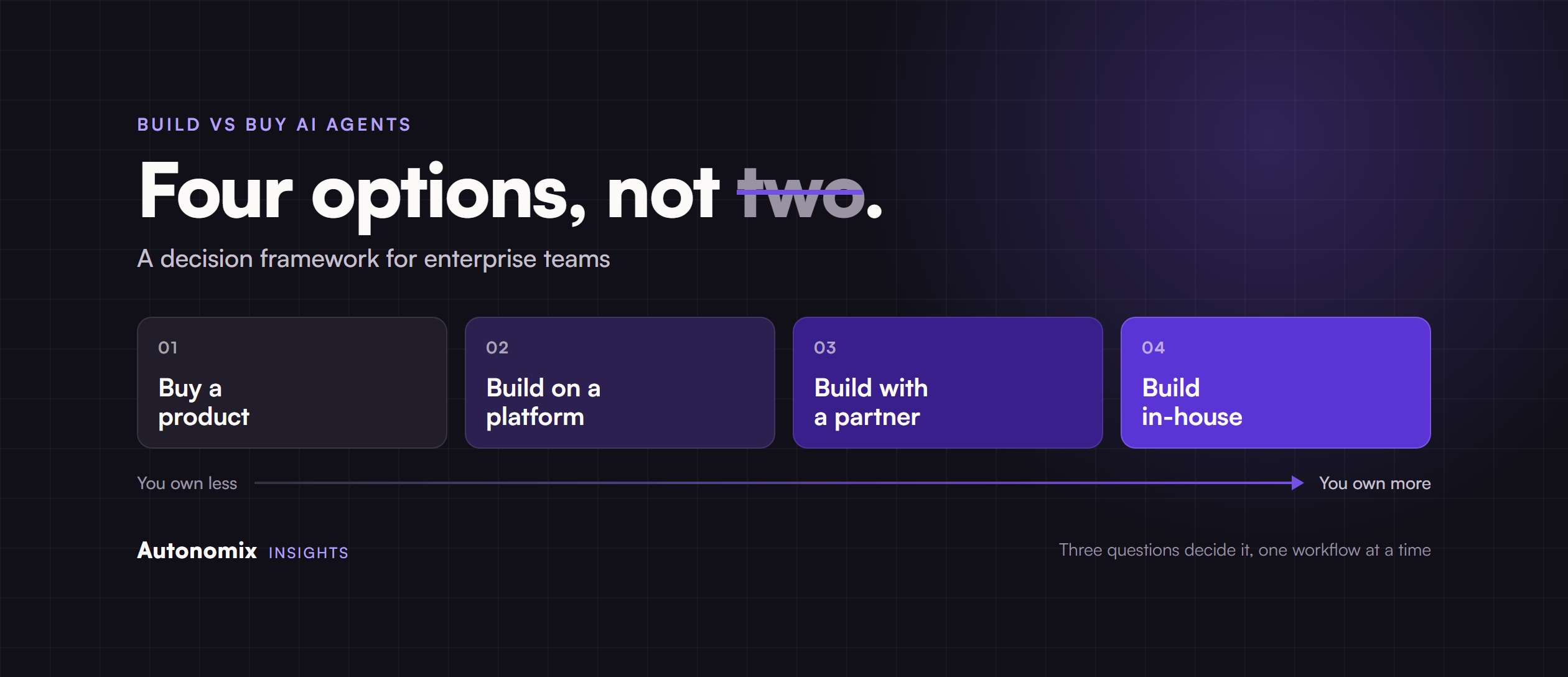
Short answer: For most enterprises, the first AI agent should be bought: customer questions, IT tickets and invoice matching work the same way everywhere, and good products already exist for them. The exception is the workflow your customers choose you for. If a competitor could buy the same agent and erase your advantage, or the agent has to change data in five of your systems, build it on a platform or with a partner. Autonomix, an AI consulting and deployment firm with eleven enterprise AI systems in production, sells three of the four options, and this guide still says buy whenever buying wins.
How the four options differ
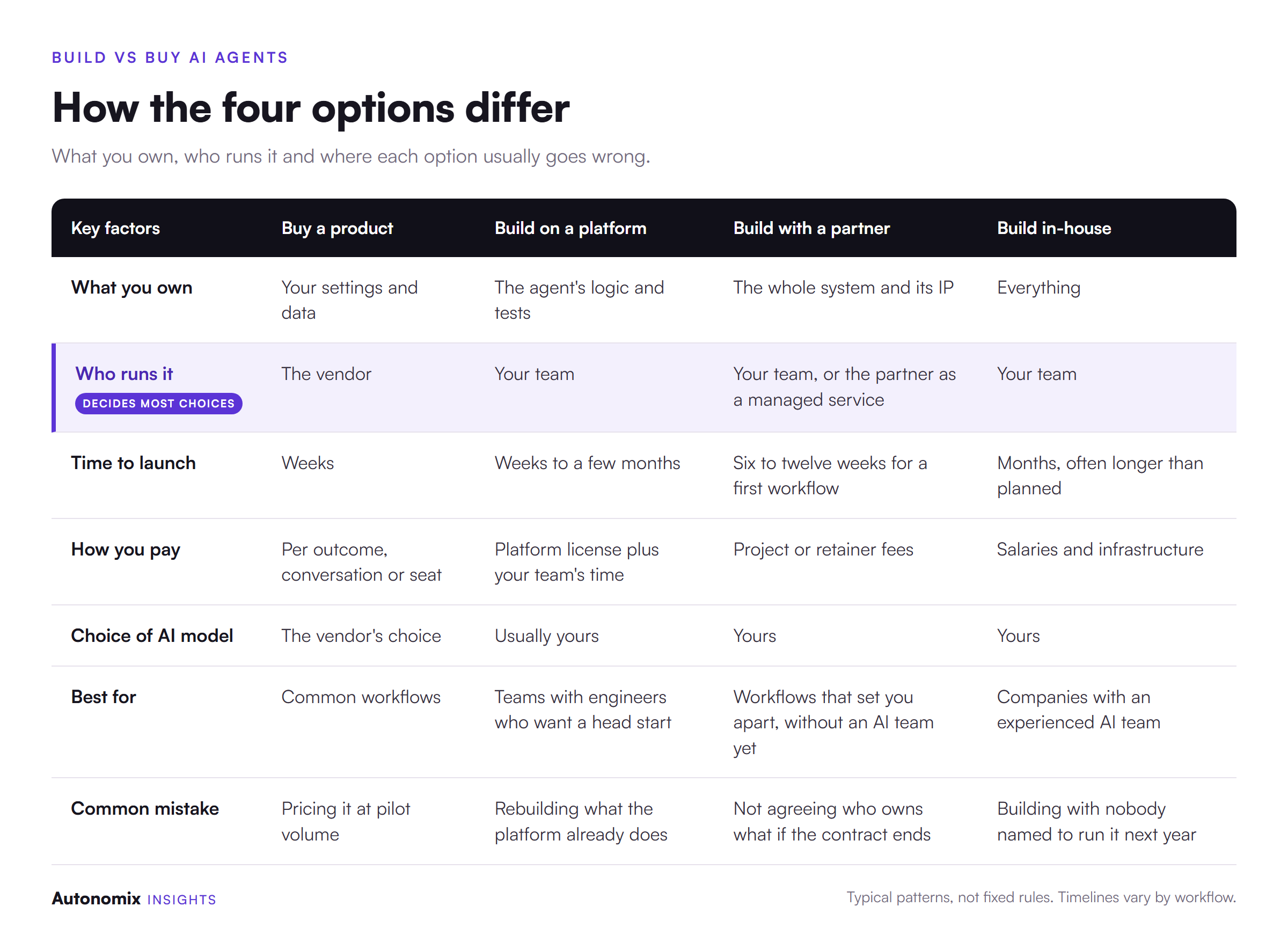
The row that decides most choices is "who runs it." An agent isn't finished at launch. Someone on the vendor's side or yours has to test it when the AI model changes, fix it when it gets answers wrong and approve every update. If nobody on your side can do that, buying or a partner who runs the system for you is the safer path.
What the research says
The headline numbers favor buying. Read a little closer and they make a narrower point.
- Enterprises bought 76% of their AI use cases in 2025, up from 53% a year earlier, because ready-made tools were "reaching production more quickly and demonstrating immediate value" (Menlo Ventures, 2025: The State of Generative AI in the Enterprise, December 2025, 495 US decision-makers).
- External partnerships reached deployment about 67% of the time, against about 33% for tools built internally (Project NANDA, The GenAI Divide, July 2025, self-reported outcomes).
- More than 40% of agentic AI projects, meaning AI that acts on its own, are expected to be canceled by the end of 2027, and only about 130 of the thousands of vendors selling "agentic" products offer real agents (Gartner, June 2025).
Two caveats before you act on these numbers. The NANDA figure groups bought products with partner builds, so it shows that teams building alone struggle most, not that buying always wins. Bought tools also tend to solve smaller problems, which reach production more easily anyway. Buying doesn’t remove the risk either: Gartner’s cancellation forecast covers bought projects too. Our analysis of why AI pilots fail looks at the NANDA paper in more detail.
What AI agents cost in 2026
The vendors that publish prices charge per customer issue handled, not per seat. That makes buying easy to budget, and easy to underestimate at scale.
- Intercom Fin: $0.99 per outcome, charged once per conversation
- Zendesk: $1.50 per automated resolution on a commitment, or $2.00 pay-as-you-go
- Salesforce Agentforce: $2.00 per conversation
- Sierra: no published price; says it uses “outcome-based pricing”
- Decagon: no published price; available through a demo
Prices from each vendor’s own website, accessed October 2026. Each vendor counts its unit differently, so test them against your own traffic.
Those fees grow fast. At $0.99, 2,000 outcomes a month costs about $24,000 a year, while 200,000 a month costs about $2.4 million.
Build costs are harder to pin down, because no independent study covers them.
Vendors selling the alternative quote $150,000 to $300,000+ (Maven AGI) and $100,000 to $500,000 per agent before maintenance (Lyzr), so treat both as opening bids. Work out your own break-even instead:
Break-even monthly volume = yearly cost to build and run ÷ (12 × price per outcome)
At $600,000 a year to build and run, building beats $0.99 outcomes above about 50,500 a month. Our guide to AI implementation cost lists every cost line to include.
Three questions that decide it
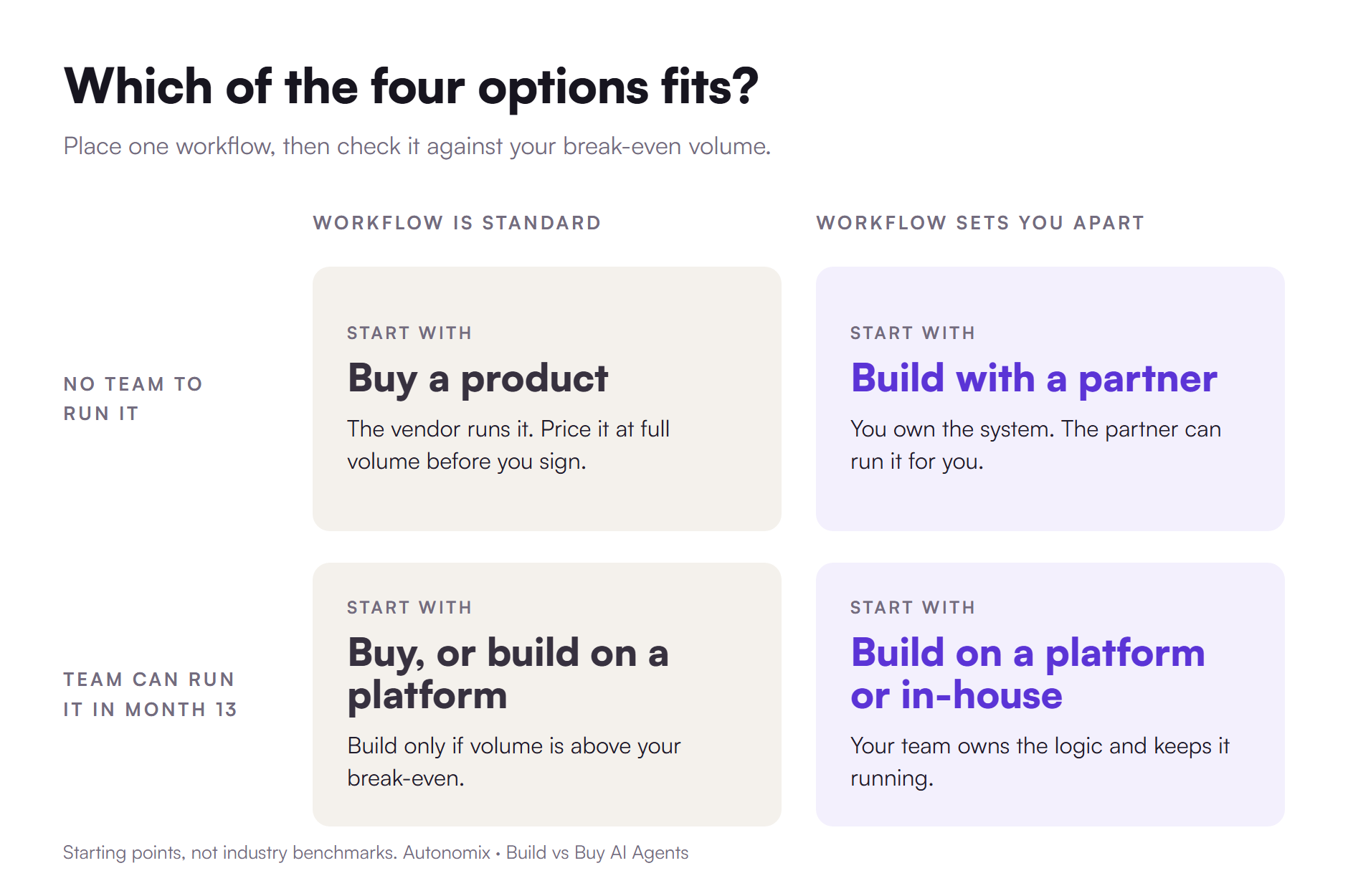
Find your quadrant before you compare quotes. Then check it against your break-even volume.
1. Does the workflow set you apart?
Imagine your biggest competitor buys the same agent tomorrow. If you'd lose nothing, as with password resets or invoice matching, buy it. If you'd lose the judgment customers pay you for, such as how you grade an exam or which delayed shipment you reroute first, that judgment belongs in a system you own.
A quick way to check is to ask your best operator to walk through the workflow while you count how often they say "except" or "unless." Every exception becomes a workaround in a bought product. More than five usually means the product will fight your process.
2. How deep does it reach into your systems?
Trace one request through every system it touches. A refund can touch five: orders, customer records, payments, stock and the audit log. The more systems the agent changes, and the more its access differs from one user to the next, the more a build makes sense.
Check where the data has to live too. Many products run in the vendor's cloud on an AI model the vendor picked. If your data can't leave your own environment, or you want the freedom to switch AI models later, lean toward building on a platform.
3. Who will run it a year from now?
Name the person who'll test and approve the switch when your AI provider retires the model version your agent uses. If you can name someone, you can build. If you can't, buy, or build with a partner who runs the agent for you.
Nvidia's chief executive, Jensen Huang, put it this way at CES 2025: "In a lot of ways, the IT department of every company is going to be the HR department of AI agents in the future" (Fortune, January 2025). An agent you build needs that kind of manager from its first day.
Four starting points
These are starting points, not industry benchmarks. Adjust them for your volume, your data rules and the team you actually have.
- Standard workflow, no team to run it → Buy a product. Signals: few exceptions, one or two systems, vendor hosting is acceptable. The vendor carries running costs and updates.
- Standard workflow, high volume or strict data rules → Build on a platform. Signals: volume above break-even, or data that can’t leave your environment. You own the logic without building the plumbing.
- Workflow sets you apart, no AI team yet → Build with a partner. Signals: a competitor buying the same agent would hurt you, and the agent changes data in three or more systems. You own the system, and the partner brings experience and can run it.
- Workflow sets you apart, experienced AI team → Build on a platform or in-house. Signals: a named owner for next year, and a team that has launched agents before. Your team keeps full control.
Three real workflows show how this plays out. Tier-one support on web chat was a clear buy. Havells’ WhatsApp training for a 650,000-person sales force was built on AutoSage, because no product was designed for 60,000+ people using it at once, as happened at the February 2026 campaign peak. TeamLease EdTech’s grading of 38,000+ answer sheets a month was built too, because the grading standard is the product, and the process is now the subject of a patent application co-filed with TeamLease.
How to check a vendor or a partner before you sign
Most bad decisions come from questions nobody asked in the demo.
- Ask to see it on your data. Demo data hides the hard cases. Your own tickets, orders or documents show them.
- Ask what happens when it's wrong. A real agent hands the case to a person. A relabeled chatbot apologizes and repeats itself.
- Ask which AI model it uses and whether you can change it. This tells you how exposed you are to one provider's prices and roadmap.
- Ask what you get back if you leave. Data, settings, conversation logs and test results, and in what format.
- Ask a build partner which client they told to buy instead. A partner who has never said "buy" is selling, not advising.
Our analysis of why AI pilots fail covers what a build needs beyond the AI model itself, including a clear owner, an early security review and a cost model that holds at full volume.
Four mistakes that waste the budget
- Deciding for the whole company. "We're a buy company" is a policy, not a decision. The same business can rightly buy for IT support and build for its core operation.
- Pricing at pilot volume. A fee that looks small at 2,000 conversations a month can be a seven-figure bill at 200,000. Run the break-even formula on your real volume before you sign.
- Building with nobody to run it. A working agent with no owner goes stale within months. Name the owner before the first line of code.
- Signing without exit terms. If you can't take your data, settings and test cases with you, the cost of leaving is part of the price. Get the answer into the contract, not the pitch.
How to measure the decision
Judge the choice on what the agent delivers in production, not on what the demo promised. Review these monthly and decide quarterly.
- Cost per completed task at your real volume, including the people who review its mistakes
- Accuracy against your own set of test cases, rerun every time the agent or its AI model changes
- The share of cases the agent hands to a person, and how fast that share is falling
- How long a change takes, from a request to a tested update in production
Take today's numbers for speed, errors and cost per task before the agent goes live. Without that baseline, you can't prove the agent helped, whichever option you chose.
Get a second opinion on one workflow. Bring the workflow, its current numbers and your expected volume, and we'll talk through which of the four options fits. Talk to Autonomix.
Frequently asked questions
Should we build or buy AI agents?
Decide one workflow at a time. Buy when the workflow is common and nobody can run an agent. Build, usually on a platform or with a partner, when the workflow sets you apart, changes data in many core systems or runs above your break-even volume. Most enterprises end up doing both.
What is build vs buy in AI?
It's the choice between buying a ready-made AI product and building your own. For AI agents there are four options: buy a product, build on a platform, build with a partner or build in-house. They differ most in what you own and who runs the agent after launch.
How much does an AI agent cost per resolution?
Published prices in October 2026 ran from $0.99 per outcome for Intercom Fin to $2.00 per conversation for Salesforce Agentforce, with Zendesk at $1.50 to $2.00 per automated resolution. Sierra and Decagon don't publish prices.
How much does it cost to build an AI agent?
No independent study publishes a reliable figure. Vendor estimates run from $100,000 to $500,000 per agent before maintenance. A better guide is your own break-even point: the yearly cost to build and run, divided by twelve times the price per outcome.
How long does it take to build a production AI agent?
With an experienced team and proven patterns, a first production workflow typically takes six to twelve weeks. A new team starting from scratch should plan for considerably longer, and budget for the security review early.
What is agent washing?
It's Gartner's term for chatbots and automation tools relabeled as AI agents without real agent capabilities. Gartner estimates only about 130 of the thousands of agentic vendors are genuine. Asking what happens when the agent is wrong usually exposes them.